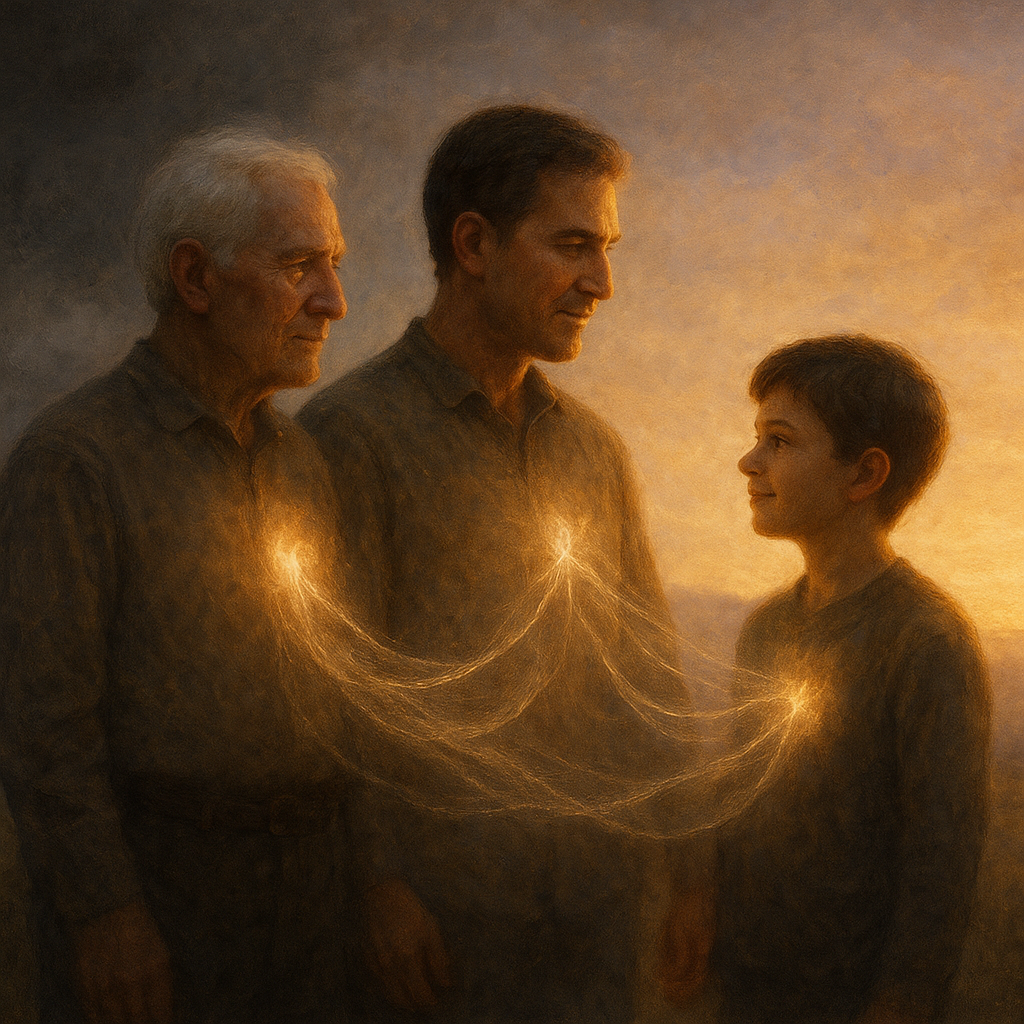
Some patterns seem to follow families like shadows — the same emotional struggles, relationship dynamics, or self-destructive habits appearing across generations, almost as if they’ve been quietly passed down alongside eye colour and surname. This isn’t coincidence. It’s what researchers and therapists refer to as generational trauma, and understanding it may be one of the most important steps you take towards genuine, lasting healing.
Whether you’ve noticed cycles of anxiety, addiction, emotional unavailability, or even specific fears repeating in your family line, this guide is here to help you make sense of what’s happening — and explore what it looks like to begin breaking free from it.
What Is Generational Trauma?
Generational trauma — also called intergenerational trauma or transgenerational trauma — refers to the psychological, emotional, and even physiological effects of trauma that are passed down from one generation to the next. It doesn’t just mean that a traumatic event happened in your family’s past. It means that the impact of that event continues to shape how descendants think, feel, behave, and relate to others, often without those individuals ever consciously realising why.
The concept gained significant scientific traction through research into Holocaust survivors and their children, which found that descendants showed elevated stress hormones, heightened anxiety, and trauma symptoms even when they had not personally experienced the original events. Similar findings have emerged from studies on communities affected by slavery, war, famine, and systemic oppression.
It’s worth noting the distinction people often ask about: generational trauma vs intergenerational trauma. In practice, these terms are used interchangeably. Both describe trauma that transfers across generations within a family or community. Some academics use “intergenerational” to emphasise the direct transmission between two generations (parent to child), whilst “transgenerational” sometimes refers to effects seen in grandchildren and beyond — but for most practical purposes, you’ll find the terms used as synonyms.
How Is Trauma Passed Down?
This is where things get genuinely fascinating — and a little uncomfortable. Trauma is transmitted across generations through several overlapping pathways:
Epigenetic Changes
Perhaps the most striking discovery in this field involves epigenetics — the study of how gene expression can be altered by environmental experiences, including trauma. Research suggests that extreme stress can cause chemical changes to DNA that affect how genes are expressed, and that these changes can be inherited. A landmark study published in Biological Psychiatry found that the children of Holocaust survivors had altered cortisol profiles (a key stress hormone) consistent with their parents’ trauma responses — even though the children hadn’t experienced the Holocaust themselves.
Parenting Behaviours and Attachment Styles
Trauma profoundly affects how people parent. A parent who grew up in a household marked by emotional neglect may struggle to express warmth, not out of indifference, but because they were never shown how. A parent with unresolved post-traumatic stress may be emotionally unpredictable, hyper-vigilant, or withdrawn — all of which shape a child’s developing sense of safety and their attachment style. These patterns then influence how that child eventually parents their own children.
Learnt Behaviours and Coping Mechanisms
Children absorb far more than they’re explicitly taught. They observe how adults handle conflict, express (or suppress) emotions, cope with stress, and relate to their own bodies and health. When unhealthy coping strategies — such as avoidance, emotional suppression, substance use, or explosive anger — are normalised within a family environment, they become deeply ingrained templates for navigating the world.
Family Narratives and Silence
What families don’t talk about can be just as influential as what they do. Many families dealing with collective trauma — migration, abuse, loss — maintain silence around painful events. This silence doesn’t erase the emotional weight; it simply leaves it unnamed and unprocessed, creating a kind of emotional inheritance that children carry without context.

Signs You Might Be Carrying Generational Trauma
Recognising generational trauma in yourself isn’t always straightforward. It rarely announces itself with a clear origin story. Instead, it tends to show up as patterns that feel inexplicably persistent or disproportionate to your lived experience. Some common signs include:
- Chronic anxiety or hypervigilance that doesn’t seem connected to present circumstances
- Difficulty trusting others or forming secure attachments in relationships
- A pervasive sense of shame or unworthiness that resists logical challenge
- Patterns of emotional numbing or difficulty identifying and expressing feelings
- Recurring relationship dynamics — particularly around abandonment, control, or conflict — that mirror those of your parents or grandparents
- Unexplained physical symptoms such as chronic tension, gut issues, or fatigue that don’t have a clear medical cause
- Feeling responsible for the emotional wellbeing of your parents or caregivers from a young age
- A deep, unshakeable fear around specific themes — scarcity, safety, vulnerability — even when your current life doesn’t warrant it
None of these signs are diagnostic on their own, and many have multiple potential causes. But if several resonate — particularly in the context of a family history marked by adversity — it may be worth exploring further.
How to Break the Cycle of Generational Trauma
Breaking the cycle of generational trauma is neither quick nor linear — but it is absolutely possible. Thousands of people across generations have done it, often starting with nothing more than a growing awareness that something needed to change. Here’s what that process can look like:
1. Build Awareness and Name What You’re Dealing With
The cycle often begins to break the moment someone in a family line decides to look honestly at the patterns being repeated. This takes courage. It means resisting the urge to minimise or excuse harmful dynamics, and it means being willing to feel uncomfortable as you examine your history with fresh eyes. Journalling, family history exploration, or simply having honest conversations with trusted people can all help bring these patterns into focus.
2. Seek Trauma-Informed Therapy
Working with a therapist who understands trauma — particularly intergenerational trauma — can be profoundly transformative. Approaches that tend to be especially effective include:
- EMDR (Eye Movement Desensitisation and Reprocessing) — widely used for processing traumatic memories and reducing their emotional charge
- Somatic therapy — focuses on the way trauma is held in the body and uses physical awareness to support healing
- Internal Family Systems (IFS) — helps individuals understand and integrate different “parts” of the self, many of which were shaped by early trauma
- Attachment-based therapy — addresses relational wounds and helps build healthier patterns of connection
- Narrative therapy — supports people in rewriting the stories they’ve inherited about themselves and their families
3. Develop Emotional Literacy
Many people who carry generational trauma grew up in environments where emotions were suppressed, ridiculed, or treated as dangerous. Rebuilding a relationship with your own emotional world — learning to identify, name, and safely express feelings — is foundational work. Practices like mindfulness, reflective journalling, and somatic body scans can all support this.
4. Reparent Yourself
The concept of reparenting involves intentionally giving yourself the things your caregivers couldn’t provide — consistent emotional support, validation, boundaries, and compassion. It’s about becoming the kind of stable, nurturing presence for your inner self that perhaps wasn’t available to you in childhood. This process can feel unfamiliar at first, but over time it helps to rewire deep-seated beliefs about safety, worthiness, and love. For many, this work connects closely to healing the wounded child within, a powerful complement to addressing inherited trauma.
5. Set Boundaries Without Guilt
Healing generational trauma often requires setting new boundaries within family systems that have long operated in unhealthy ways. This is frequently the hardest part, as family systems tend to resist change — even when change is clearly needed. Learning to hold boundaries with compassion but firmness is a skill that takes practice, and it’s entirely normal for there to be pushback.
6. Explore Cultural and Collective Dimensions
For many people, generational trauma is inseparable from collective experiences — colonisation, racism, migration, persecution, famine. Healing in these contexts often benefits from community, cultural reconnection, and engaging with the broader history of one’s people. This might involve cultural practices, community groups, or simply learning more about your ancestral history with openness and compassion.

Healing Generational Trauma: What It Actually Looks Like
It’s worth being honest about something: healing generational trauma doesn’t mean erasing your history or becoming a completely different person. It means gradually loosening the grip that past pain has on your present choices. It means responding rather than reacting, choosing rather than repeating, and ultimately creating more space — in yourself and in your relationships — for something different.
Many people find that as they heal, they start to feel genuine compassion for the generations before them — understanding, perhaps for the first time, that their parents and grandparents were also people shaped by forces largely beyond their control. This doesn’t mean excusing harm. It means holding complexity: being able to acknowledge both the wound and the humanity of those who inflicted it.
On the subject of breaking generational trauma quotes, one that resonates deeply for many on this journey comes from author and therapist Resmaa Menakem: “Trauma decontextualized in a person looks like personality. Trauma decontextualized in a family looks like family traits. Trauma in a people looks like culture.” It’s a powerful reminder that what we often accept as simply “who we are” may, in fact, be the shape trauma has taken over time — and that it can be transformed.
Supporting Children and Future Generations
One of the most profound motivators for healing generational trauma is the desire not to pass it on. If you’re a parent — or hope to be — the work you do on yourself directly shapes the environment your children grow up in. You don’t need to be a perfect parent; research consistently shows that what children need most is a parent who is present, who can acknowledge mistakes, and who is willing to repair after ruptures in the relationship.
Simple, consistent practices make an enormous difference: naming emotions with children, validating their experiences rather than dismissing them, modelling healthy conflict resolution, and being honest — in age-appropriate ways — about difficult feelings. These aren’t just parenting techniques; they’re acts of generational healing. They also lay the groundwork for building secure, emotionally healthy relationships as children grow into adults navigating their own connections.
Conclusion
Generational trauma is real, it is widespread, and for far too long it went unnamed and misunderstood. But awareness has grown enormously in recent years, and with it, access to genuinely effective pathways for healing. Understanding that your struggles may be rooted in something far older than your own lifetime isn’t a reason for despair — it’s an invitation for compassion, for curiosity, and for meaningful change.
The cycle can be broken. It begins with awareness, deepens through honest self-reflection and appropriate support, and ripples outward — changing not just your own life, but potentially the lives of everyone who comes after you. That is not a small thing. That is, in many ways, one of the most significant things a person can do.